Enclosed copy of letter and receipts sent from Treasurer to J. Ambler. Ambler cannot sign any receipts on good conscience, believes the receipts must be signed by "superior authority".
Discusses Indian land claims in the state of New York; says that certain members of the Iroquois Confederacy were expected to attend, but did not. Appears to conclude with the suggestion of an additional meeting in Albany in winter of 1795.
Disputes U.S. statement that the Americans had no knowledge of prior Indian arrangements with "Governor Clinton" [presumably former Governor George Clinton of New York]. Refers to previous, intra-Indian land disputes which preceded the current negotiations. Rails against some third party for inciting war and bloodshed, but reaffirms that the Iroquois tribes have not made war on the United States. Says that one U.S. reason for denying the Indian claim is because of some presumed consort or land transaction between the Indians and the French king. Says "[N]or do we know of aney [sic] French or English king owning eney [sic] land in Amarica [sic] before us." Gives this as justification for the integrity of the Indian land claim. Appears to be saying that the English king was granted the right to settle whites on the Iroquois land in question, but was never sold it. Says a similar agreement may have been reached with France.
Professes to answer the Indians' speech of the previous day; reiterates that the purpose of the meeting is to delineate which lands the Indians are claiming, that they may be paid for by New York. After a crossed-out section, states that he is not replying to some statements of the Indian leaders because he is not authorized to negotiate for anything beyond the purpose stated above. Following pages discuss the Indian claims to specific tracts of land, some of which have supposedly already been ceded by the Oneidas. Introduces the speech of the New York commissioners. Subsequent pages largely repeat the words of those preceding; the final page lists the lands claimed by the Indians within the boundaries of the state of New York.
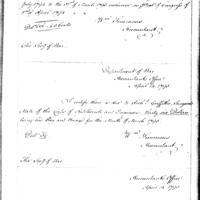
Simmons certifies that $230.00 is due Augusta De Grasse, temporary engineer at Charleston, South Carolina, being his pay for July through September 1795.
Simmons certifies that $16.30 is due Michael Truby, late Private of Captain Thomas Cushing's Company, being his pay from January 1st to June 13th 1793, the day of his death.
Thanks U.S. commissioners for their determination to do justice by the Indians. Confirms that the Indians' claim is just, and appeals to the Americans' Christianity to ensure that they continue to deal justly. Affirms wish for love and friendship between the two peoples, unto future generations -- and says that this example should be followed by all Indians. Says that word the U.S.'s just dealings will be spread throughout the Indian nations. Asks the commissioners to consider what has been said, and invites reply.
Posey asserts that he intends to resign and since the public is currently in his debt, he will no longer enlist recruits until he receives an answer from the Secretary of War relative to the settlement of his account.
Horatio Dayton has been ordered to Governors Island but will continue recruiting so he can complete Captain Thompson's Company. Dayton has asked for money for the recruiting service so Simmons is asked to forward to him the appropriate amount.
Following his instructions, Dale returns the receipts of his company. The men who can write signed their names while the others were witnessed as they made their marks.
A list of names made by Hodgdon and yet to be accounted for who were employed for the militia on the expedition against the Insurgents in the Western Counties of Pennsylvania. Advances were charged to General Henry Miller, Quarter Master General of the Militia Army, who made the stoppages.