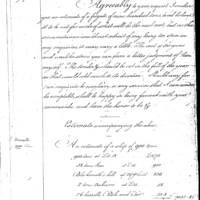
Mentioned "An act to provide a naval armament," and upon peace with Algiers all construction should cease. He requested Congressional opinion on halting construction due to the effect it would have on the workers, families, economy, and all materials already appropriated for the project.
De Leyritz forwards an authentic piece as requested by Simmons in order to provide better intelligence of the matter of pay. He reminds that when called in by Major Rivardi he was to be paid $45 per month and later, the Secretary of War approved his pay at $2 per day.
Asks for information regarding Congressional intentions towards Navy. Asks after Captain Dale. Mentions the business of continuing construction of frigates is up before Congress.
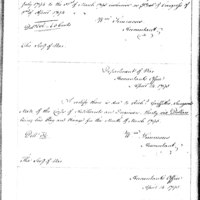
Simmons certifies that $87.94 is due Daniel Stevens, Superintendent at Charleston South Carolina, being his commission on receiving and paying money for the Dept. of War between June 27, 1794 and Dec. 31, 1795.
Simmons certifies that $131 is due Francis Brewster, Surgeon's Mate, Lieutenant Peter Tallman and the men under his command, being his and their pay for February 1796.
Discusses the account and vouchers submitted to the War Office by the Governor of Virginia for militia pay, pay of scouts, and protection of the frontiers
Notifies Miller that John Chester will deliver money for Miller's pay and the pay of his men. Discusses issues concerning the pay account of Miller's company.
Simmons certifies that $535.45 is due Captain Edward Miller and the men under his command at Middletown Connecticut, being his and their pay for January and February 1796.
Cited in Miller to Simmons, 03/27/1796.
This letter encloses the Receipt Roll for Edward Miller and his men for the months of January and Febuary 1796.
McHenry argues for the necessity of a strong military force to counteract the force maintained by Great Britain and Spain on the northern and southern boundaries of the United States. McHenry advises against reducing the U.S. military below its present force.
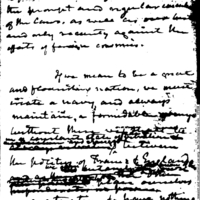
Persuades importance for a national navy, comparing the US to France and England. Deplores challenge of not being able to depend upon the current navy for protection.
"I have the honor to submit to the committee on the military establishment, the thoughts that have occurred to me on the question respecting which they seemed to desire my opinion."
Henry Starks convicted of losing sundry articles of public property and sentenced to stoppage of pay until cost was recouped by United States. Starks claims the stoppage of entire pay was mistake, requests investigation.
Court martial of Privates Jacob Wildman and Christian Wood for desertion relayed to Simmons. Rochefontaine gave detailed account of how he handled the pay of deserters, settlement of accounts, and his adherence to the rules laid by the Secretary of War.