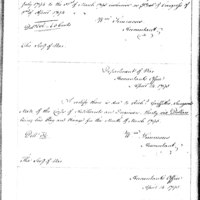
Simmons certifies that $567.50 is due the Scouts of Washington County, Pennsylvania for their services on the frontier of said County from Dec. 1, 1795 to Jan. 28, 1796.
Simmons certifies that $433.89 is due Tench Francis, Purveyor of Supplies, for sundry expenses attending three St. Regis Indians and their Interpreter from Feb. 26 to March 26, 1796.
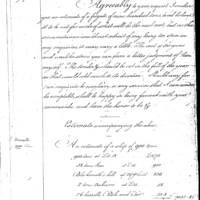
Live oak for the dead wood from Georgia is long overdue. Therefore, Stodder has permission to use white oak for pieces that were directed to be made of live oak. This white oak can be found, according to Captain Truxton, in the Maryland countryside. Closes by discussing matters of pay.
A set of bills has been drawn on the Secretary of War in favor of Jeremiah and Abijiah Hunt on account of the pay of the Army for December 1795 and January 1796.
A set of bills has been drawn on the Secretary of War payable to Thomas Hart and Son on account of the pay of the Army for December 1795 and January 1796.
Simmons certifies that $516.69 is due Hastings Marks, late Captain in the 1st Sub Legion, being the difference in pay and subsistence between Lieutenant and Captain from July 1, 1794, the day he was promoted, until May 18, 1795, the day he resigned.
John Steele writes to McHenry that he disagrees with the administration's view of the Jay Treaty, arguing that the federal government had agreed to stay neutral in the conflict between Britain and France and was now violating that neutrality. Steele takes particular offense with the treaty's terms that America must comply with Britain's anti-French maritime policy. Steele also believes that because one of the duties of the House of Representatives is to regulate commerce with foreign nations, the House must approve of the treaty before it goes into effect.
Reports that they are doing as well as can be expected. Believes to have a full stock within 8 or 9 months, if he can send the locks as requested. They have had peace since Mr. Miles left. Reports prices for Indian corn. Requests an inventory of his tools because they are wearing out quickly and it will be difficult to ascertain their value. Intends to send a new gun design that may benefit the military.
Hale submits his accounts starting from May of 1795. He explains in the letter what he has included and omitted, and why. Despite a lack of vouchers, he includes his expenses for travel when dispatched for the recruiting service.
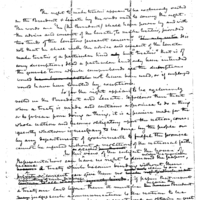
McHenry argues that the right to make treaties is exclusively vested in the President and the Senate, according to the Constitution. McHenry also asserts that the House of Representatives has no right to demand the papers behind a treaty without the President's permission, despite the Congressional power to regulate commerce with foreign nations. McHenry suggests that the reason Congress demands the papers is in order to make a case for impeachment.
Submits returns for needed articles via William Clark. Clark will go to Fredericksburg to seek to recruit a new file cutter to recast their files. If he succeeds, they won't need the files requested in the return. Requests other articles as soon as possible, perhaps by water to Richmond. Clark will present an order for his pay for January, February, and March, deducting whatever money was given to his daughter.